
Our Senior Creative Manager, Freya, on brands, creativity and finding inspiration
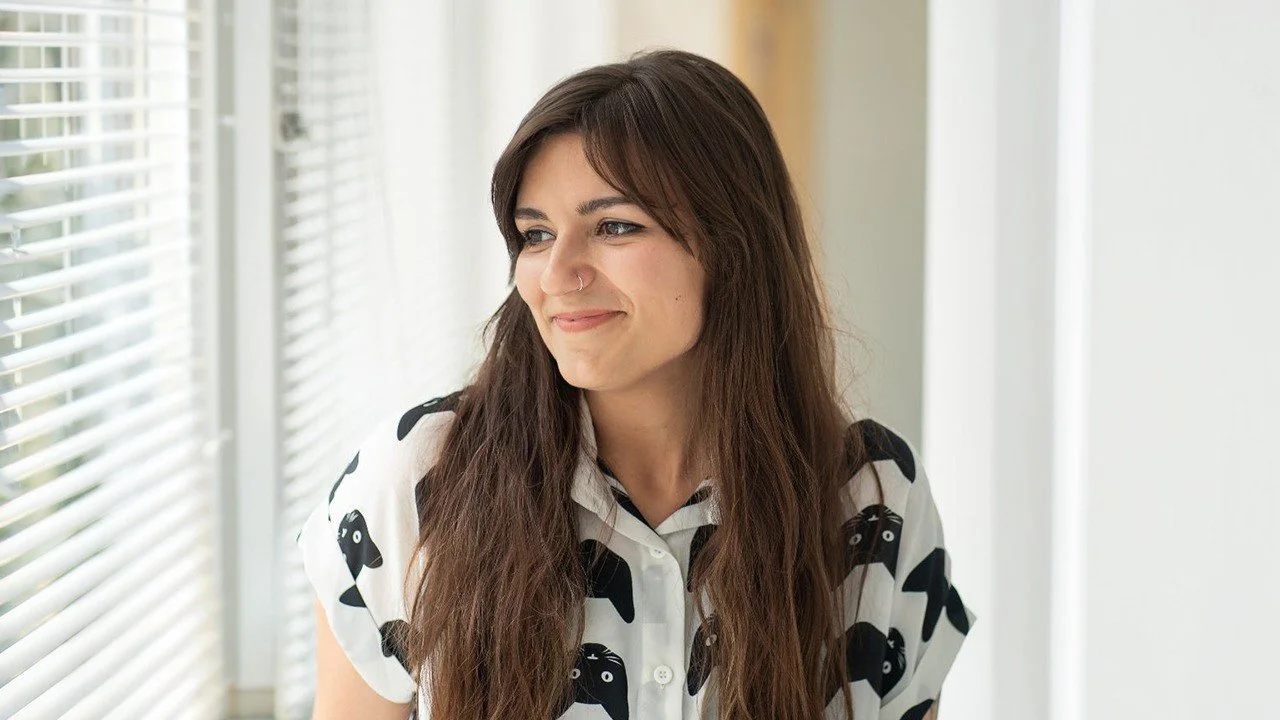
R: Hey Freya, and welcome to Ravel! Can you tell us a bit about yourself?
F: I’m a designer and creative based in London. I’ve spent the last several years working across brand, campaigns, and content, mainly with organisations trying to make a positive difference. Outside work, I’m a parent to a very cool but intense four-year-old, like to travel, and usually have a random project or two on the go. I can’t seem to stop making things.
R: What was it about Ravel that drew you to the team?
F: This is my first move from in-house to agency life, and the appeal was the chance to work on a wider range of projects — still contributing to social impact, but across different causes and challenges. Ravel’s mix of creative ambition, strategic thinking and purpose really resonated with me.
R: How do you see creativity helping to unlock solutions to the social challenges we face?
F: Facts tell us what is going on in our world. It’s how we communicate these realities – through framing, storytelling, and design – that turns complicated problems into things people can understand, feel and relate to. Creativity is how we bring other people along with us to make change.
R: What’s a piece of creative work (a campaign, film, art, music, etc.) from anywhere that made you think differently?
F: Work sticks with me when it trusts the audience’s intelligence and imagination. I’m a bit of a gamer, and I was recently thinking about Halo 3’s ‘Believe’ ad. Using physical figurines, not CG or even gameplay, paired with classical music... it feels more like art than advertising. It doesn’t show the product, it bets on curiosity and emotion. I think when brands trust audiences to fill in the gaps, as long as you know your audience, that can really pay off.
R: Can you share a brand that you feel uses creativity in a meaningful way to bring people together across cultures and contexts?
F: Nando’s! They’ve built a distinctive brand character bringing their whole story together — their roots in South African and Mozambican cuisine, Portuguese culture and legend, the space they’ve carved out in UK culture... It all comes through visually, tonally and in how they show up as a brand. I admire their impact work in southern Africa, supporting malaria elimination and fair livelihoods for the farming communities who grow their chillies. They produce beautiful creative work and films linked to these initiatives and celebrating music and culture. It feels authentic, and that deepened my respect for the brand.
R: When you’re developing work, how do you approach balancing magical big ideas with clear strategic thinking?
F: For me it's remembering they depend on each other. Big ideas don’t work if they won't meet the audience where they are, if conditions aren’t there to deliver them, or they land at the wrong moment. You can push your thinking, but the strategy – and a bit of reality – always has to come back in as a filter. Your strategy should shape your big ideas.
R: What’s your go-to ritual when you need a burst of inspiration, and what has been the most unexpected source of a creative idea so far?
F: A walk or a gym session can help shift my headspace. Music can do the same. I collect design and art books, postcards and random photos and screenshots of ads or packaging. I’ll flip through them when I’m stuck with design. Sometimes a colour pairing or typography positioning will spark something.
Years ago I was on a course at Chelsea College of Arts led by an art director. He talked about how we often stay in a bubble. We ask other creatives for feedback, but that only gives us one kind of perspective. Most of the people we’re designing for aren’t creatives. Since then, I’ve tried to test my ideas with ‘non-creatives’. Their feedback is raw — they just tell you if it makes sense to them or not. It doesn’t mean we don’t trust our own expertise, but sometimes the person you least expect has the most important insight.
R: On a tough day, what keeps you excited about what you do?
F: Knowing that around the corner is that feeling you get when it all clicks together.
R: What song, book, or show do you think every creative should experience at least once?
F: Ways of Seeing by John Berger. When I first picked it up from a reading list for one of my university classes, I didn't expect much. It looked like a book about old paintings. Berger unpacks the idea that seeing is more than looking, that the way we interpret and create images isn’t neutral. It’s influenced by social norms, gender, class, culture and more, and those images shape us in return, almost like a continuous feedback loop.
It’s very of its time, yet relevant. I think the reminder that images are never just images, but carry meaning, biases and power, is still so important for creatives. Particularly now that not all images are created by humans.
R: What’s your favourite creative tool (digital or analogue) that you can’t live without?
F: I do sketch sometimes, but honestly my instinct with visual work is to jump straight into Adobe Illustrator. I’ll set up colours, shapes, any photography, and just start experimenting. Designers used to do this in the physical space, cutting shapes, photography and textures, as well as drawing. I’d like to explore more analogue techniques this year. It would be a nice break for screen-sore eyes, too.
R: How would you describe a perfect creative day, from start to finish?
F: A slow morning, coffee, a good breakfast. Weirdly, I sometimes do my best work when I’m hungry for lunch, but never breakfast! Ideally the temperature is warm, sky is clear, sun is out, my space is relatively clean and tidy. Environment really affects me.
In a perfect day I’d ‘eat the frog’ — tackle whatever I’m avoiding first and finish the morning with a win to stay motivated. If I’m feeling stuck or distracted, a nice café by myself with good coffee, pastries and the hum of people in the background stops me going off course. I’d take plenty of time alone to gather inspiration and experiment, then finish with some team chats to get other perspectives and pick apart what’s left of the problem.
R: What one piece of advice would you give young creatives who are just starting out and want to contribute meaningfully in the social impact space?
F: Trust your instincts, but be a listener and lead with empathy. If you want to work in social impact, you’re dealing with real challenges and real people, and you have a responsibility. You see how powerful creativity can be, for better or worse. When you have someone’s story in your hands, you have to treat it with respect.
