
Meet Dida, Ravel’s long-time friend and newest Senior Creative Advisor
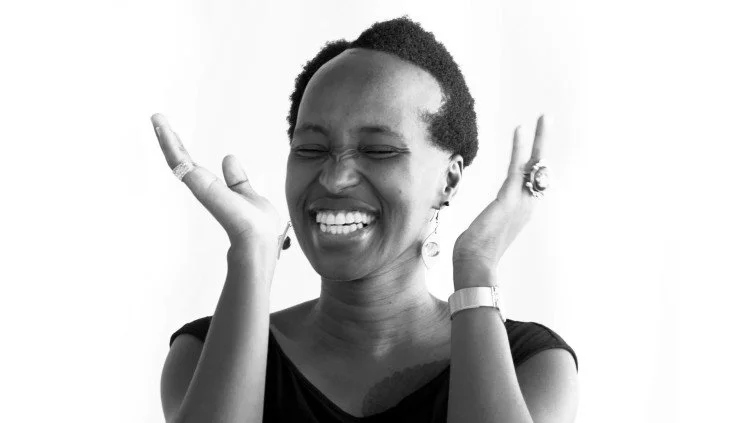
Photo credit: Akanyoni (Leslie Akimana)
We are so excited to be working with Dida again. First stop is a catch-up on all her incredible creative work in Rwanda.
R: Hi Dida, it’s so wonderful to be talking with you today. Can you introduce yourself, who you are and what you do?
D: My name is Dida Nibagwire, I’m a cultural entrepreneur. I run a production company called Iyugi and I also run a cultural centre called L‘Espace that I co-founded with my friend and fellow artist Wesley Ruzibiza.
R: Could you tell us a bit more about Iyugi?
D: Iyugi is a Kinyarwanda name. In Rwandan traditional dance, there are small bells, amayugi, that are worn on the legs, and they bring rhythm to the dancing. An Iyugi is one of these bells and when we started the company – we wanted it to be about us bringing that underlying rhythm, beauty, momentum to the quality of the work so that the work shines and is its most creative and powerful.
We started Iyugi in 2015 with the aim of creating jobs for ourselves and other artists like us. We started out producing work including radio dramas and commercial videos and then in 2017 transitioned to independent film production. One of our first projects was casting and technical advisory for the film adaptation of Gael Faye’s novel Small Country. Our recent productions are Father’s Day, a film by renowned Rwandan director Kivu Ruhoradoza and le Silence des mots, a documentary film by Gaël Faye and Michael Sztanke.
R: And, as if Iyugi wasn’t enough, we know you have gone on to create L’ Espace – can you tell us the L’Espace story?
D: L’Espace is something I always knew I wanted to do and that it was something my close friends who were artists wanted too. We were producing a lot of work but didn’t always have the right, dedicated spaces to showcase it, especially for performing arts like theatre and dance. We would travel to perform abroad and when we were producing here, we were often performing in schools or hotels so there was always that thing of wanting a space where artists can come together, create, meet, and connect with the audience. At a certain point we realised we can’t wait for anyone else to give us a space we like, the way we envision it, so we decided to just start somewhere ourselves. That's how L'Espace began – with three friends. We started with a theatre and exhibition space and now it’s a modular, multipurpose space for dance, art, films, and we have a coffee shop. We really felt like that was what Kigali needed at the time – a place created by artists that would feel like home to other artists.
R: So, who is finding a home at L’Espace and what does that look like?
D: L’Espace is for anyone who has something to share. First and foremost, it’s a space for artistic expression. We are home to a lot of young and emerging artists, alongside more established artists – and we focus on knowledge exchange between artists and across disciplines. But I really think it’s this idea and feeling of being a home that brings people back. Often an artist will come in for a particular event and will want to be part of L’Espace themselves. It's like a circle, people come in and they stay, and they bring others. That feeling of wanting to use a dedicated space, to share ideas and create, where you can interact with the audience in a certain way – in an intimate way. The focus is on consuming and connecting through art. And we are so lucky because artists are supportive of and invested in this idea of L‘Espace as a dedicated, collective, artistic home.
R: You’ve really carved out a space to put art first. What have been some of the standout L’Espace moments for you so far?
D: There are so many. But if I think back, the first performance we had was a concert of a friend of ours and renowned artist Samuel Kamanzi, and the place was full. Now we have proper seats but back then we were still in this mostly empty warehouse, we didn’t have enough seats for everyone that came, but we’d done our best to make it feel intimate and cosy. And I remember when he started singing, and we had all the lights and this beautiful sound. I remember thinking ‘This is it; this is it!’. The feeling was right.
R: At Ravel, we often talk about how it’s the people who are part of a journey that matter. You’ve recently joined Ravel as a Senior Creative Advisor. Why have you joined Ravel and what do you hope we can achieve together?
D: I think with Ravel, for me - I couldn’t say no. So many of the amazing people I’ve met on my journey as a producer and an artist are people I met through Ni Nyampinga. Knowing that some of my favourite people from Ni Nyampinga are working with Ravel, I felt it’s not just about what I bring to Ravel but me continuing my learning journey. I feel like Ravel is an extension of me and what I believe. I’m so on board with Ravel’s approach – harnessing creativity as a tool for social change - and if I can contribute a small part to that, it’s my pleasure.
R: We are so happy you have joined us. Your understanding of creativity and its role in Rwanda will be a huge part of what we do going forwards. And this is something we are exploring at Ravel at the moment – reflecting on the ways creativity is a force for good in our work – and the world. What are your reflections on why creativity matters?
D: In some ways, I get scared when I talk about bringing societal change. I’m just one person and I can’t change the entire world – but I can contribute. And I feel like creativity is often the way each of us can play our small part in bringing about change. Creativity pushes us out of the normal way of doing things and seeing things, creativity is a way of reflecting deeply on issues and things we want to resolve. Creativity demands this human-to-human connection, and I think before you try to change the way things are, you really have to embody them, you have to understand, you have to know what it’s like in the shoes of the people you are working to support – and I think creativity is what helps us to do this. I think when people see themselves in each other and in the story of change, then change is possible. For me, that’s how creativity creates change and when I think about my creative work over the past years – that’s the fulfilment in what I do. When I feel I’ve been able to give voice to someone else, to their story.
R: That’s so beautiful and true. Creativity helps us see, feel, and understand things in a way we might not have otherwise. So, Dida, on a personal note as an incredibly creative person yourself - you write, you perform - what helps you to be creative, or when do you feel most creative?
D: Well, my days change a lot depending on the state of my life, my mind, what I have on or am going through but one thing I know for sure is I’m not an early person. Evenings are a time that works for me when I feel creative. I think people find their own ways to be creative. For me, it seems to happen more at night. I’m someone who likes spending time out – seeing people outside work or home, outside of their normal routine – it gives me ideas.
R: We’re really excited to see what ideas you have next Dida, before we finish, can you tell us what have you got coming up in 2023, what exciting things we can look forward to?
D: I’m working on a documentary film coming out next year. And then L’Espace is really the thing in my life right now. I’m trying to give it the time and care it needs.
R: It feels like there’s just SO much potential for L’Espace, and we are also very excited to have you alongside us at Ravel. Thank you for taking the time today.
